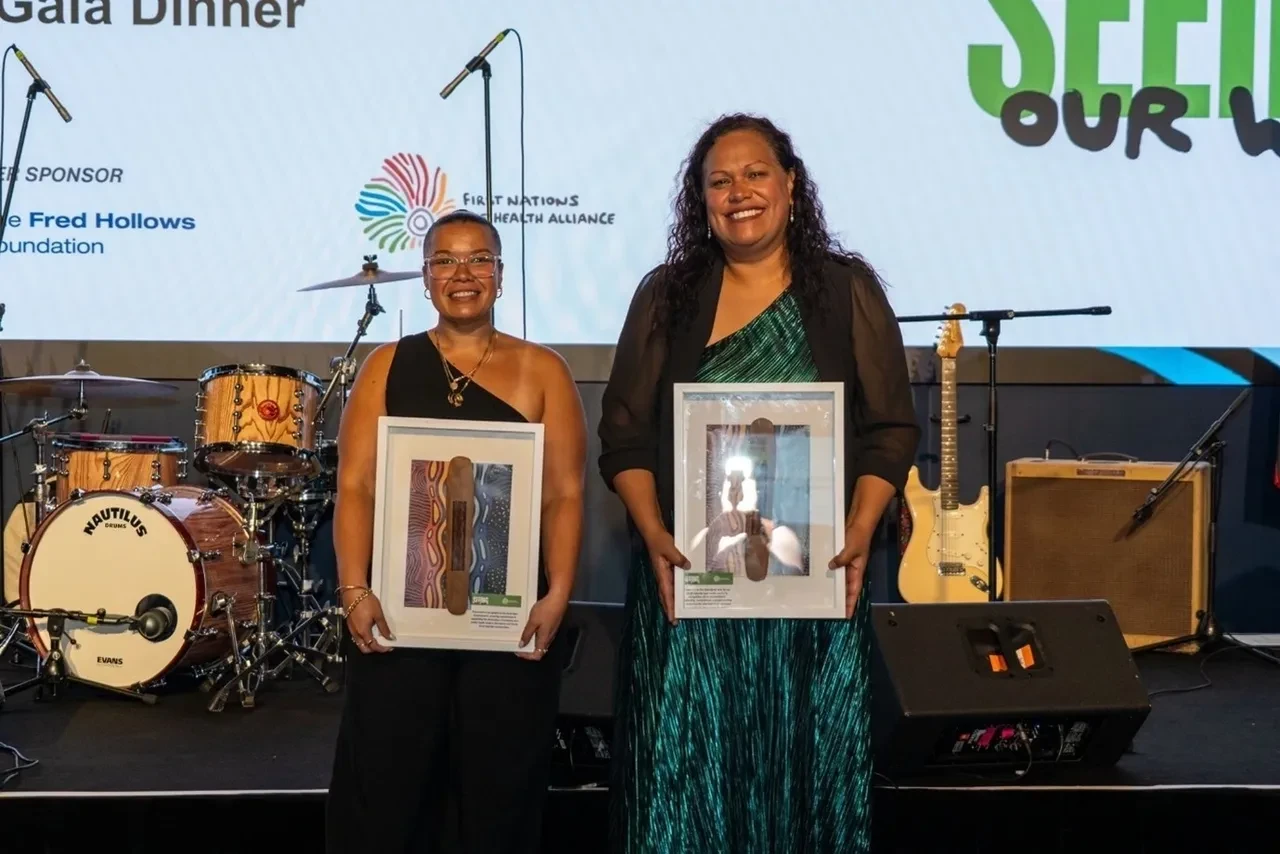
Photo: L-R Telaine Cowdrey and FNEHA CEO Lose Fonua at 2026 National Aboriginal and Torres Strait Islander Eye Health Conference, 12th May 2026, Naarm.
The First Nations Eye Health Alliance (FNEHA) proudly acknowledges a landmark public health achievement: the World Health Organisation (WHO) has formally validated Australia's elimination of trachoma as a public health problem.
Trachoma is the world's leading infectious cause of blindness. Caused by the bacterium Chlamydia trachomatis, it spreads through close personal contact, contaminated surfaces, and flies exposed to eye and nasal discharge. Repeated infections can cause scarring of the eyelids, in-turned eyelashes, severe pain, and irreversible blindness if left untreated. Importantly, trachoma is entirely preventable.
In Australia, trachoma has disproportionately affected Aboriginal and Torres Strait Islander peoples living in regional and remote communities. It has long been recognised as a disease linked to inequity, overcrowding, and limited access to essential health infrastructure.
WHO validation marks a significant milestone for Aboriginal and Torres Strait Islander eye health and for global efforts to eliminate neglected tropical diseases (NTDs). Australia now joins a growing number of countries contributing to the WHO NTD Road Map 2021–2030 and the global elimination of preventable blindness.
"The elimination of trachoma is a historic public health victory for Aboriginal and Torres Strait Islander peoples, and a powerful example of what community-led action can achieve. For too long, trachoma reflected the inequities experienced in some of the most remote communities in Australia. This milestone shows that preventable blindness can be eliminated when governments, communities, and Aboriginal community-controlled health services work together with long-term commitment and shared purpose."
Australia's achievement reflects decades of sustained public health action in Aboriginal and Torres Strait Islander communities, with progress driven by the Aboriginal and Torres Strait Islander eye care sector, communities, leadership, community-controlled health organisations, health workers, clinicians, researchers, and government partners.
FNEHA notes that continued vigilance and investment in Trachoma Elimination as a public health problem will be critical to maintaining elimination status and ensuring future generations remain free from trachoma.
Milestone Celebrated at 2026 National Aboriginal and Torres Strait Islander Eye Health Conference, Naarm
At the 2026 National Aboriginal and Torres Strait Islander Eye Health Conference on Wurundjeri Woi Wurrung Country earlier this month, FNEHA, in celebration with the broader Aboriginal and Torres Strait Islander eye care sector, recognised this historic milestone with the provision of special awards acknowledging the extraordinary contributions of the Aboriginal and Torres Strait Islander eye health sector and the Australian Government.
"Australia eliminating trachoma as a public health problem is a globally significant achievement and a proud moment for Aboriginal and Torres Strait Islander eye health. This achievement reflects decades of leadership from communities, health workers, clinicians, and researchers who refused to accept preventable blindness as inevitable. While we celebrate today, this milestone must also drive continued action to maintain elimination and ensure all Aboriginal and Torres Strait Islander peoples continue to have equitable access to eye care and the opportunity to enjoy lifelong vision and eye health."
On behalf of the Aboriginal and Torres Strait Islander eye care sector, the First Nations Eye Health Alliance looks forward to formally presenting this historic award to Minister for Health and Aged Care Mark Butler and Assistant Minister Rebecca White in Canberra, in recognition of the Australian Government's achievement in eliminating trachoma as a public health problem.
For media enquiries, please contact Nikita Ridgeway, Executive Officer, [email protected].